I encourage writers to do their research, then cultivate a style that is proper and distinctive.
The other day I posted this to Twitter:

It was inspired by the coincidence that in less than two weeks, three separate clients of mine were having serious issues with ellipses.
- A student 3-page paper, which presented a first for me in terms of odd punctuation. The writer highlighted his omitted material thusly:
“Quote quote quote… …quote quote quote.”
- A 107,000 word psychological thriller in which the author used four dots, with no defining spacing between words or sentences, to convey dream states.
Action movement action movement….Movement action movement….Action action….
- A women’s lit manuscript, at 47,000 words, that had no consistent formatting for any ellipses use. Some examples:
Sometimes….and… . Or….. then. “… why?”
Last night, I received a clever response from an author in the U.K.

I was thrilled! He got it!
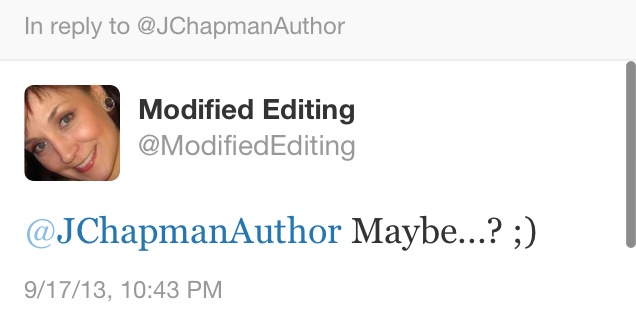
He got it… right?
Suddenly, I wasn’t sure. While the wording in his first example is correct, the punctuation supporting the wording isn’t for the instance. The second example is correct, but the follow-up (“Maybe not.”) had me worried I’d either been far too ambiguous in my original tweet, or he was actually asking for clarification of his own tweet. So I posted subsequent tweets, anything I could think of on the subject, over and over, each playing off of the last.
I’d hoped to take the opportunity to have fun with ellipses and post #EditTips galore. What an exciting time on Twitter! Most of my twittersations are with other editors, a few of my clients, industry connections, friends, and a great deal of DMs asking for a breakdown of my services. Instead, I’d done a thing I detest: twomited. My feed was full of… ME.

A twittaintance, the writing partner of one of my wonderful clients, often replies to her own previous tweets in order to promote her Amazon.com ebook. What may seem to her a simple blurb, “Buy my book at blergyblerg-book.com/first/get_it_now/”, looks to the rest of us like a connection of cubes thanks to the new Twitter-reply feature.


Bleck. Barf. Twarf.
So I deleted them all and plopped them here. One link will be tweeted, leading to this post. No twomit.
- To indicate a pause… for effect… it would be written as I have done here. Ellipses are three dots and a space… nothing more.
- Unless used to indicate thought has trailed off. Well then, in that case…
- An ellipsis followed by a question mark indicates a tentative question. “Clear…?” he asked with uncertainty.
- I believe “4-point” ellipsis is a misnomer. It is an ellipsis followed by a period. AKA “terminal ellipsis”. Am not fond!
- Only when omitting portions of quoted text that leave off at the end of a sentence, should one use an ellipsis followed by a period. But even then, there are choices less ambiguous.
- According to MES, “only when omitting … should one use an ellipsis …”. Note too, the spacing is different.
- I will use your profile bio to show a pause AND omission: “Err… no classification for […] books.”
- When not using a word processor that automatically formats ellipses, one should write them as: dot space dot space dot.
- Or, if for omission: space dot space dot space dot space.
Style manuals tend to be less in agreement on the ellipsis then most other punctuation. I encourage writers to do their research, learn acceptable options, then cultivate a style that is proper and distinctive. Honestly, if you don’t make up squiggly marks, and are consistent, you’re good to go. After all, once your manuscript is chosen for representation and then picked up by a publisher, it is very likely the pub house editors will have another streamlined a format.
 Modified Editing Services